
Decision Support for AI and Security Initiatives
This page explains a decision-support service provided by Fragment Practice for AI, security, technology-risk, and operating initiatives.
Fragment Practice helps organizations prepare material for decision, explanation, review, execution, and handoff when the topic is important but the conditions for moving forward are not yet clear.
Use cases may have been collected.
Guidelines may be drafted.
Security, legal, risk, IT, and business teams may already be involved.
A product, vendor, or implementation partner may also be under consideration.
Management may be asking for a plan.
Still, the organization may not yet be ready to move forward.
Which use case should move first?
What information can be entered, referenced, or generated?
Who reviews the output or operating condition?
Where does responsibility remain?
What should management or related departments decide?
What should be handed off to product adoption, implementation, operation, or external partners?
When these questions remain unclear, the issue is not always a lack of tools.
The organization may need decision material, responsibility boundaries, review points, and execution conditions before moving further.
Fragment Practice helps prepare those materials.
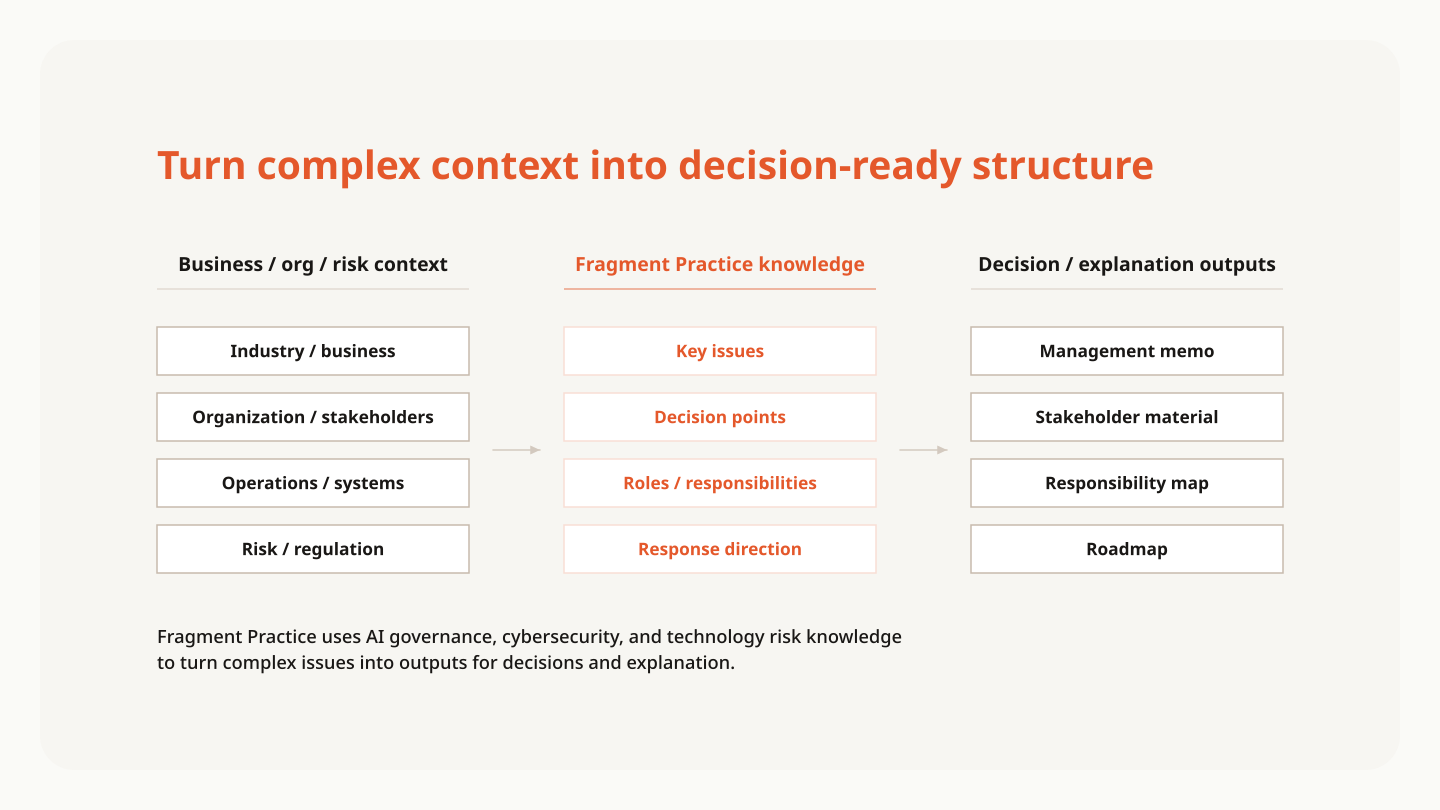
What Fragment Practice provides
Fragment Practice helps organize AI, security, technology-risk, and operating topics into material that can be used for decision, explanation, review, execution, and handoff.
The work focuses on issues that often appear before or alongside product adoption, implementation, management approval, related-department review, or external partner engagement.
This includes clarifying:
- use cases and priorities
- information and risk conditions
- review points and constraints
- responsibility boundaries
- stakeholder explanation points
- execution conditions
- handoff items for later work
The output is not only a clean document.
The output is material that stakeholders can use in the next meeting, review, approval process, vendor discussion, implementation planning, or handoff.
This service is useful when a broad topic needs to become practical material for action.
Topics this service can support
This service can be applied to themes such as:
- generative AI adoption and governance
- Copilot or internal AI usage rules
- AI use case review and prioritization
- information input and output-use rules
- security governance for AI-enabled operations
- technology-risk review for new tools or services
- external AI or security service usage
- product or vendor adoption readiness
- management reporting for AI or security initiatives
- cross-functional explanation for legal, security, risk, IT, and business teams
- responsibility boundaries between internal teams and external partners
- handoff material for implementation, operation, or later design work
The request does not need to be fully defined at the beginning.
In many cases, the first step is to clarify the request itself.
Common situations
External support is often useful when the topic has already become visible, but the next step remains difficult.
For example:
- AI use cases exist, but priorities are unclear.
- Generative AI guidelines exist, but practical review points are not defined.
- Security, legal, risk, IT, business, and management perspectives are not yet connected.
- A product or vendor is being considered, but internal execution conditions are unclear.
- Use cases exist, but information boundaries and responsibility boundaries are difficult to explain.
- Management or related departments need material for review, approval, or explanation.
- The organization needs to hand off issues to implementation, operation, vendor engagement, or a later phase.
In these situations, selecting another tool or starting implementation immediately may not solve the problem.
The first task may be to prepare decision material.
Decision material is different from a general explanation document.
It should help stakeholders understand:
- what is being considered
- what needs to be decided
- what can proceed now
- what needs review
- where responsibility remains
- what conditions must be met before the next step
- what should be handed off to later work
Without this material, AI and security initiatives can remain in discussion even when many people agree that the topic is important.
What Fragment Practice clarifies
Fragment Practice structures these issues into material that can be used in practical business situations.
The work is not only to summarize the current situation.
It is to clarify what should be decided, what should be reviewed, who should be involved, what conditions need to be met, and what should be carried forward.
| Current issue | Structuring focus | Material after structuring | Expected effect |
|---|---|---|---|
| It is unclear what should move first. | Use case clarification and prioritization | Management decision brief / options for next steps | Management and business leaders can see what needs to be decided next. |
| Information use and risk conditions are unclear. | Information classification, review points, and constraints | Stakeholder explanation / review checklist | Security, legal, risk, IT, and business teams can review from a shared premise. |
| Roles and responsibilities are hard to explain. | Responsibility boundaries and review model | Role and responsibility map / review model | Stakeholders can see who reviews, decides, explains, and carries the next step. |
| Product adoption, implementation, or vendor engagement lacks clear premises. | Execution conditions and handoff items | Roadmap / handoff material | Implementation, operation, and external partners can proceed with clearer assumptions. |
This structure helps the organization move from discussion to usable material.
The purpose is not to make the document look complete.
The purpose is to make the next action possible.
Main service activities
Depending on the situation, Fragment Practice may support the work through several activities.
Clarifying the current situation
This includes reviewing the current materials, use cases, stakeholder concerns, open issues, and expected next decisions.
The purpose is to separate what is already clear from what still needs review, decision, or handoff.
Organizing use cases and priorities
This includes identifying which use cases should move first, which need additional review, which should be handled later, and which may be outside the current scope.
The output can support management reporting, internal alignment, and next-step planning.
Structuring information and risk review points
This includes organizing input information, reference information, output use, confidentiality, access rights, logs, external service use, and review conditions.
The purpose is to help security, legal, risk, IT, and business teams review the initiative from a shared premise.
Clarifying roles and responsibility boundaries
This includes clarifying who uses, who reviews, who approves, who explains, who operates, and who carries issues into the next phase.
The output can become a role and responsibility map, review model, or stakeholder explanation material.
Preparing execution and handoff conditions
This includes organizing assumptions, open issues, implementation premises, vendor discussion points, operating conditions, and next-phase handoff items.
The purpose is to help later work start from usable premises rather than from discussion history alone.
Materials that can remain after the work
The exact output depends on the context, but typical materials include:
- key issue memo
- use case and priority map
- information and risk review points
- input and output-use conditions
- responsibility boundary map
- review and approval model
- management decision brief
- stakeholder explanation material
- product or vendor readiness assumptions
- roadmap and handoff notes
- open issues for later work
These materials are designed to be used by people in different roles.
Management can use them to understand what decision is being requested.
Business teams can use them to see what can proceed.
Security and legal teams can use them to review information, risk, and responsibility.
IT and product teams can use them to understand execution premises.
External partners can use them to work from a more stable scope.
Later teams can use them as handoff material rather than only discussion history.
The value is not only in the meeting or the discussion.
The value is in what remains after the discussion.
Practical effects
This work does not remove every uncertainty.
It separates uncertainty into forms that the organization can handle.
For example:
- what can proceed now
- what needs related-department review
- what requires management decision
- what should be handed off to product adoption, implementation, or operation
- what should remain as an open issue for later work
After the issue has been structured, the organization should be able to move with less hidden ambiguity.
Expected effects include:
- management can see what needs to be decided
- related departments can see what they need to review
- business teams can see under what conditions they can proceed
- security, legal, and risk teams can avoid reviewing vague requests
- IT and product teams can receive clearer execution premises
- external vendors can receive a more stable scope
- later teams can receive assumptions, open issues, and handoff conditions
This makes AI and security work easier to explain, review, approve, implement, operate, and hand off.
Relationship with products, vendors, and implementation partners
AI products, security products, and implementation partners provide important capabilities.
They may provide controls, guardrails, monitoring, automation, integration, logging, testing, and operational support.
Fragment Practice does not replace that work.
The role is different.
Before product adoption or vendor engagement can move effectively, the organization often needs to clarify:
- which use cases the product should support
- which risks the product is expected to reduce
- which information is in scope or out of scope
- which parts should be controlled by the system
- which parts still require human review
- who owns the operating decision
- what management or related departments need to understand
- what assumptions should be handed off to implementation or operation
This is the connection point between Fragment Practice's support and product implementation.
When the premises are clearer, products and implementation partners can work from a stronger foundation.
Fragment Practice's support is not a substitute for implementation.
It prepares the conditions under which implementation, product adoption, vendor discussion, and operation can move forward with fewer hidden assumptions.
From short-term structuring to medium-term advisory support
Support can be scoped depending on the stage of the topic.
For short-term needs, Fragment Practice can help clarify the situation, organize the main issues, and prepare decision material or stakeholder explanation within a bounded scope.
This may be useful before:
- management reporting
- related-department review
- vendor discussion
- product adoption planning
- implementation planning
- internal policy or guideline review
For medium-term needs, Fragment Practice can continue to support the initiative after the initial structuring.
This may include periodic advisory support, review of evolving materials, clarification of responsibility boundaries, preparation for management or stakeholder discussions, and handoff support as the initiative moves toward implementation, operation, or external partner engagement.
Support can begin with initial structuring and continue as scoped advisory support when the topic requires ongoing decision support.
Service entry points
Fragment Practice supports this work through several service entry points.
Initial structuring session
A focused session to clarify the current situation, identify key issues, and separate what can proceed from what needs review.
This is useful when the topic is still early, when the request is not yet well defined, or when multiple stakeholders need a shared starting point.
Decision-material sprint
A short, bounded engagement to produce decision-ready material for management, related departments, product readiness, or next-phase handoff.
This is useful when the organization needs practical material within a defined timeframe, such as before management reporting, vendor discussion, internal review, or implementation planning.
Scoped advisory support
Ongoing advisory support for AI governance, security governance, technology-risk, responsibility boundaries, review points, and operating design.
This is useful when the initiative will continue over several weeks or months and needs periodic review, external perspective, or structured decision support.
Products as supporting material
For teams that want to proceed internally, Products may provide useful supporting material.
Products can be useful when internal owners already exist and the team needs reusable working material, templates, or kits for structuring issues, role boundaries, review points, meeting outcomes, or handoff conditions.
If the issue depends on organization-specific risks, stakeholders, management explanation, vendor engagement, or responsibility boundaries, a scoped service engagement may be more appropriate.
Products can help internal teams start.
Services are used when the situation needs contextual structuring.
Scope of support
This support does not include:
- system implementation
- day-to-day operations
- resident PMO
- broad execution outsourcing
- legal judgment replacement
- audit assurance
- product resale
- always-on help desk support
The work helps clarify what should be decided, what should be reviewed, who should be involved, what conditions need to be met, and what material should be carried forward.
This makes later implementation, product adoption, vendor discussion, management approval, or internal operation easier to move.
Contact Fragment Practice for cases like these
Please contact Fragment Practice if your organization is facing a situation such as the following:
- an AI, security, technology-risk, or operating topic is important, but the scope is still unclear
- AI use cases exist, but they are not yet organized into decision material
- security, legal, risk, IT, and business perspectives are not aligned
- management or related departments need explanation material
- a product or vendor is being considered, but internal premises are not ready
- responsibility boundaries and review points need to be clarified before implementation or operation
- the organization wants to start with issue structuring and continue with advisory support as the initiative develops
The first step does not need to be a large project.
Fragment Practice can begin by clarifying the current situation, identifying the main issues, and preparing material that helps the organization decide, explain, review, operate, and move to the next phase.
Short-term structuring can also lead into medium-term advisory support when the topic continues to develop.